English
  русский
  Français
  Indonesia
  عربى
عربى  中文简体
中文简体


Diesel Trailer Generator Cooling: Why Towed Radiators Overheat and Fail
Контент
A rental depot replaced eleven radiators last year on towable diesel generators rated below 200 kVA. Two had cracked headers. The other nine had never failed at all: their fins were packed solid with site dust and road grit until coolant temperature ran 10 to 12 degrees above the panel limit.
A diesel trailer generator is a diesel generator set mounted on a road-towable chassis, normally rated between 20 kVA and 500 kVA, in which the engine, alternator, radiator, fan and control panel are packaged to move between sites without dismantling. Movement is what separates its cooling system from a stationary skid: less clean air, more vibration, and a tighter enclosure.
Why a Towed Chassis Changes Radiator Duty
A trailer-mounted diesel generator loses cooling margin in three places a stationary skid never touches: interrupted airflow, road-induced vibration, and dust drawn along the towing vehicle's wheel path.
Airflow is the first and largest loss. A fixed installation pulls air from a plant room, pushes it in one direction and never sees it again. A towable set draws air through enclosure louvers on the side of a trailer, and at low wind speed a share of the hot discharge curls back into the intake. A recirculation penalty of 5 to 10 °C at the radiator inlet is normal on a still day, and it stays invisible on most control panels.
Vibration is the second. A trailer frame flexes and twists over rough ground, and the joint between core and top tank absorbs those loads. A core bolted rigidly instead of isolated on rubber will crack at the tube plate within a season of weekly moves.
Towable set in service
- Air enters through louvers and can recirculate from the trailer deck
- Road shock loads the core-to-header joint on every trip
- Grit, mud and salt spray reach the fin face directly
- Access through hinged panels with tight clearances
- Axle and towing limits cap core thickness and coolant volume
Stationary skid in a plant room
- Air path designed once, with fixed discharge direction
- Vibration is continuous but low amplitude and predictable
- Intake air filtered by the room or a dedicated screen
- Full access for cleaning and inspection
- Only floor space limits core size and fan diameter
Field rule: enclosure louvers, rain caps and the trailer frame usually cost 10 to 15 percent of the airflow area available on an open skid. Radiator cores for towable generating sets are therefore specified one row deeper or one fan size up for the same engine rating.
Radiator Sizing Numbers That Decide the Build
Size a trailer generator radiator in a fixed order: coolant heat rejection first, air-side flow second, ambient margin third, physical fit last.
Cooling load drives everything else. A diesel engine converts roughly a third of its fuel energy into crankshaft power and rejects a similar share to the coolant, so a 200 kW set typically asks the radiator to remove 130 to 160 kW. That figure, not the kVA on the nameplate, sets how much core area the trailer has to carry.
| Parameter | Working figure | What it changes on a trailer |
| Heat rejected to coolant | 0.6-0.8 kW per kW of engine output | Core depth, row count and coolant volume |
| Air-side face velocity | 5-8 m/s | Fan diameter and static pressure budget |
| Design ambient | 40 °C standard, 50 °C tropical | Core size and fan power draw |
| Coolant flow | 1-1.7 L/min per kW at a 6-10 °C rise | Pump, hose bore and header nozzle diameter |
| Pressure cap rating | 1.0-1.5 bar | Boiling point margin, especially at altitude |
| Fan power draw | 3-6 % of engine output | Net kVA actually available to the load |
Air is the only medium that carries heat out of the fins, so a 4,000 m site leaves the radiator with roughly two thirds of the cooling air it was sized for at sea level.
A jump from a 40 °C to a 50 °C design ambient shrinks the temperature difference the radiator works with from about 55 K to 45 K, close to 18 percent less driving force at the same coolant temperature. That margin is bought with core area, not with a faster fan.
Dust, Vibration, and Real Failure Patterns
External fin plugging and header fatigue, not internal corrosion, account for most trailer generator radiator replacements.
Dust behaves differently from scale. A 1 mm film of site dust on the air side can cut heat transfer by 10 to 20 percent without leaking a drop of coolant, and on a trailer that film builds from the outside of the core inward, where no coolant filter will ever catch it. Mud and salt spray make it worse by cementing the layer onto the fins.
Externally plugged fins
Wash from the fan side outward at low pressure. A high-pressure jet aimed straight into the core bends fins and permanently reduces airflow.
Header and tube plate fatigue
Check the rubber isolators and the frame braces at every service. A cracked bracket transfers road shock straight into the core.
Fan and belt wear
Dust in the pulley grooves changes effective belt length. Set tension by deflection, not by feel, and recheck after the first 50 hours.
Coolant chemistry drift
Glycol depletes, scale forms and liner pitting starts. A 50/50 mix with a maintained inhibitor package protects the tubes the radiator cannot see.
A fixed radiator maintenance schedule keeps the air side clean and the coolant within specification, which is where most of the service life is won or lost.
A radiator running with 30 percent of its fin face blocked does not fail on the spot. Coolant temperature creeps up 8 to 12 °C, the set derates itself, and the generator quietly delivers less than the nameplate kVA it was rented for.
 Mining Site Generator Radiators for Dusty High-Vibration OperationsDust-blocked fins can derate generators, so this range uses wide-spacing fins, reinforced tanks and anti-dust coatings for remote mining cooling.View Product →
Remote and Off-Grid Trailer Generator Duty
A remote trailer generator radiator is sized for the worst week, not the average day, because altitude, dust and a long service interval all land on the same core.
Air is the working fluid. At 2,000 m the atmosphere holds about 82 percent of the air mass found at sea level, and at 4,000 m about 67 percent. The fan still turns at the same speed, but every pass through the core carries away less heat. Combine that with a site that sees a wash-down once a month instead of once a week, and the radiator needs spare capacity before it ever leaves the factory.
An oversized core is not wasted metal on a towable set. Lower face velocity means dust that does reach the fins blocks less of the air path, and the fan draws less power, which is why remote-rated radiators are usually one to two rows deeper than the truck-mounted equivalent for the same engine.
 Remote Type Generator Radiators for Flexible Outdoor Heat RejectionWhen generators sit indoors or in tight spaces, remote radiators reject heat outside while keeping noise and exhaust away from the room.View Product →
Rental Fleets: Specs That Survive Every Move
A rental fleet should standardize on one radiator platform per power class rather than chasing each unit's original brand part number.
A working towable set is relocated 20 to 40 times a year. Every move is a fresh vibration cycle and a fresh dust load, and the cooling system takes more punishment from transport than from running hours. Fleet operators who match radiators by core dimensions, fan diameter and inlet position can swap a serviceable unit between machines of different brands in the same power class.
Move frequency
20 to 40 relocations a year per working unit, each one a new dust and shock exposure for the core and panels.
Spare-part logic
One core and one fan drive per power class removes the need to source a brand-specific part during a weekend breakdown.
The cheapest way to keep a towable diesel generator out of the derate curve is a ten-minute external wash at every relocation. Fleets that wash on arrival replace far fewer radiators mid-season than fleets that wash after a failure.
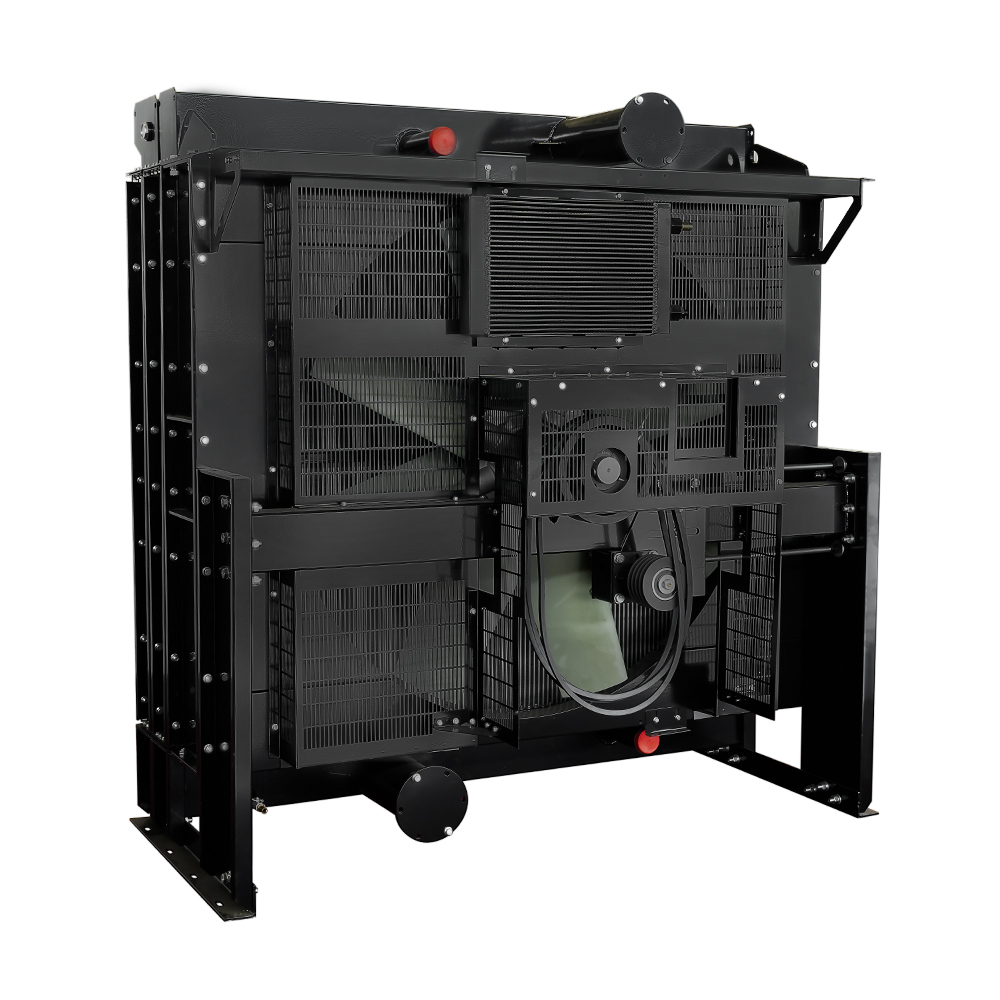 Rental Generator Radiators for Mobile and Rental Power FleetsFrequent relocation demands easy service and quick field replacement, so these interchangeable radiators help reduce downtime between rental deployments.View Product →
Replacing a Trailer Generator Radiator
Match a replacement radiator by measurement and heat rejection, not by brand label.
A compatible radiator that fits the trailer frame, matches the fan curve and clears the derate threshold will outlast an original part that was specified for a different ambient rating. Work through the checks in this order.
- Record the engine model, continuous and standby ratings, and the alternator frame size; these set the heat load the core must carry.
- Measure the core on the trailer: height, width and depth, header pattern, inlet and outlet bore and position, plus fan diameter, rotation and blade pitch.
- Confirm coolant flow rate, thermostat setting and cap rating. A 0.5 bar change in cap rating moves the boiling point by roughly 10 to 13 °C.
- Check the mounting footprint and the vibration isolators. A core bolted rigidly to a trailer frame cracks at the header within a season.
- Pressure-test the new core to 1.5 bar, hold for ten minutes, and re-torque the fan bolts before the first run.
A cross-reference is only useful when it carries dimensions. Part numbers change between build years; core depth, inlet position and fan bolt pattern do not.
For machines already in service, an end-user replacement radiator program that works from measurements rather than part numbers removes most of the risk of a wrong fit.
Frequently Asked Questions
Bring the engine rating, the core dimensions and the pressure cap value to any radiator enquiry. Those three numbers decide whether a replacement will hold its rating on a trailer.
What size radiator does a diesel trailer generator need?
Start from coolant heat rejection at 0.6 to 0.8 kW per kW of engine output, then add 10 to 15 percent of core area for the airflow lost to enclosure louvers and the trailer frame. A 200 kW engine typically rejects 130 to 160 kW to the coolant, and the core must remove that figure at the stated design ambient.
How often should a trailer generator radiator be cleaned?
Externally, at every relocation on dusty sites and at least every 250 hours on rental duty. Remote and mining units often run a 500-hour cycle because access is limited. Wash from the fan side outward at low pressure and never bend the fins with a high-pressure jet.
Can a towable diesel generator run reliably at altitude?
Yes, with a derated rating. Air mass at 2,000 m is about 82 percent of sea level, so the radiator removes less heat with the same fan and the engine loses combustion air as well. Most builders derate 2 to 3 percent per 300 m and specify a 1.5 bar cap so the coolant boiling point stays clear of the thermostat range.
Why does a trailer generator overheat after towing?
Three things usually change during a move: dust and mud pack the fins, enclosure panels or latches are left open so hot air recirculates, and coolant is lost through a loose hose or a cap left off. Check the fin face, the air path and the coolant level before blaming the radiator.